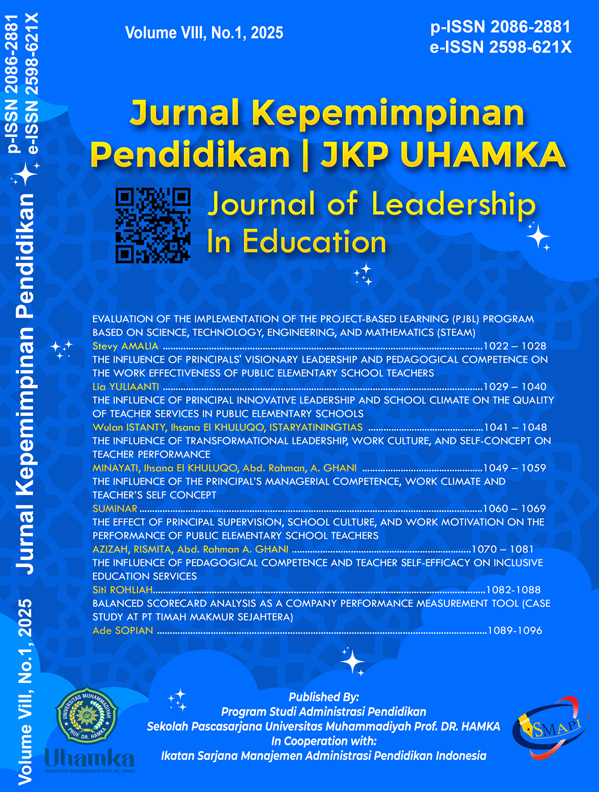
THE INFLUENCE OF PRINCIPALS' VISIONARY LEADERSHIP AND PEDAGOGICAL COMPETENCE ON THE WORK EFFECTIVENESS OF PUBLIC ELEMENTARY SCHOOL TEACHERS
DOI:
https://doi.org/10.22236/jkpuhamka.v8i1.20802Keywords:
visionary leadership, Pedagogic Competence, work effectivenessAbstract
The purpose of this study is to investigate: (1) The Influence of Visionary Leadership of the Principal on the Work Effectiveness of State Elementary School Teachers in Cluster 4 of Tangerang District; (2) The Effect of Pedagogic Competence on the Work Effectiveness of State Elementary School Teachers in Cluster 4, Tangerang District; (3) The principal's supervision of the Pedagogic Competence of State Elementary School Teachers in Cluster 4 of Tangerang District. This research is a type of correlational research. The approach used in this study uses a quantitative approach. The population in this study was 150 teachers in State Elementary School Teachers in Cluster 4, Tangerang District, totaling 109 teachers sample who were randomly sampled. The analysis technique used is path analysis technique. Based on the results of the analysis, it is known that: (1) There is a direct positive and significant influence of the principal's visionary leadership on the effectiveness of the work of state elementary school teachers in Cluster 4 of Tangerang District. (2) There is a direct positive and significant influence of pedagogic competence on the effectiveness of the work of state elementary school teachers in Cluster 4 of Tangerang District. (3) There is a direct positive and significant influence of the principal's visionary leadership on the pedagogical competence of State Elementary School teachers in Cluster 4 of Tangerang District.
Downloads
References
Aisyah, A. N., F. N. Pinkan, P. B. Danianta, and S. Balgies, “Pengaruh pengalaman dan kompetensi terhadap produktivitas kerja,” RJABM (Research Journal of Accounting and Business Management), “, vol. 5, no. 2, pp. 86–99, 2021.
Baharun, H. “Peningkatan kompetensi guru melalui sistem kepemimpinan kepala madrasah,” At-Tajdid: Jurnal Ilmu Tarbiyah, vol. 6, no. 1, pp. 1–26, 2017.
Hamdani, H. and K. Krismadinata, “Kontribusi kompetensi dan persepsi tentag supervisi pembelajaran terhadap produktivitas kerja guru,” INVOTEK: Jurnal Inovasi Vokasional dan Teknologi, vol. 17, no. 2, pp. 61–66, Dec. 2017, doi: 10.24036/invotek.v17i2.37.
Hasibuan, Malayu S.P. 2018. Organisasi dan Motivasi Dasar Peningkatan Produktivitas, Jakarta: Bumi Aksara.
Nofriyanti, E. and A. Kuswantoro, “Pengaruh kompetensi pegawai, budaya organisasi, disiplin pegawai, dan kepuasan kerja terhadap produktivitas kerja pegawai,” Economic Education Analysis Journal, vol. 8, no. 3, pp. 879–897, 2019.
P. Siagian, Sondang. 2014. Manajemen Sumber Daya Manusia, Jakarta: Bumi Aksara.
Prasasti, A., “Pengaruh kepemimpinan kepala sekolah, kompetensi guru, dan Lingkungan kerja terhadap produktivitas sekolah,” Journal of Accounting and Business Education, vol. 2, no. 2, Sep. 2016, doi: 10.26675/jabe.v2i2.6064.
Septria, Titien, M. Mahdum, and R. Rusdi, “Pengaruh kompetensi guru dan budaya organisasi terhadap produktivitas Sekolah Dasar Negeri se-Kecamatan Bangkinang Kabupaten Kampar,” Jurnal JUMPED (Jurnal Manajemen Pendidikan), vol. 6, no. 1, pp. 160–172, 2018.
Syelviani, M., “Analisis pendidikan dan komepetensi guru dalam rangka meningkatkan produktivitas kerja pada SDN 023 Tembilahan Kota,” Jurnal Analisis Manajemen, vol. 4, no. 1, 2018.
Thomas, P., “Faktor determinan produktivitas sekolah,” Jurnal Penelitian dan Evaluasi Pendidikan, vol. 17, no. 1, pp. 55–71, Jun. 2013, doi: 10.21831/pep.v17i1.1361.
Downloads
Published
How to Cite
Issue
Section
License
Copyright (c) 2025 Lia YULIAANTI

This work is licensed under a Creative Commons Attribution 4.0 International License.