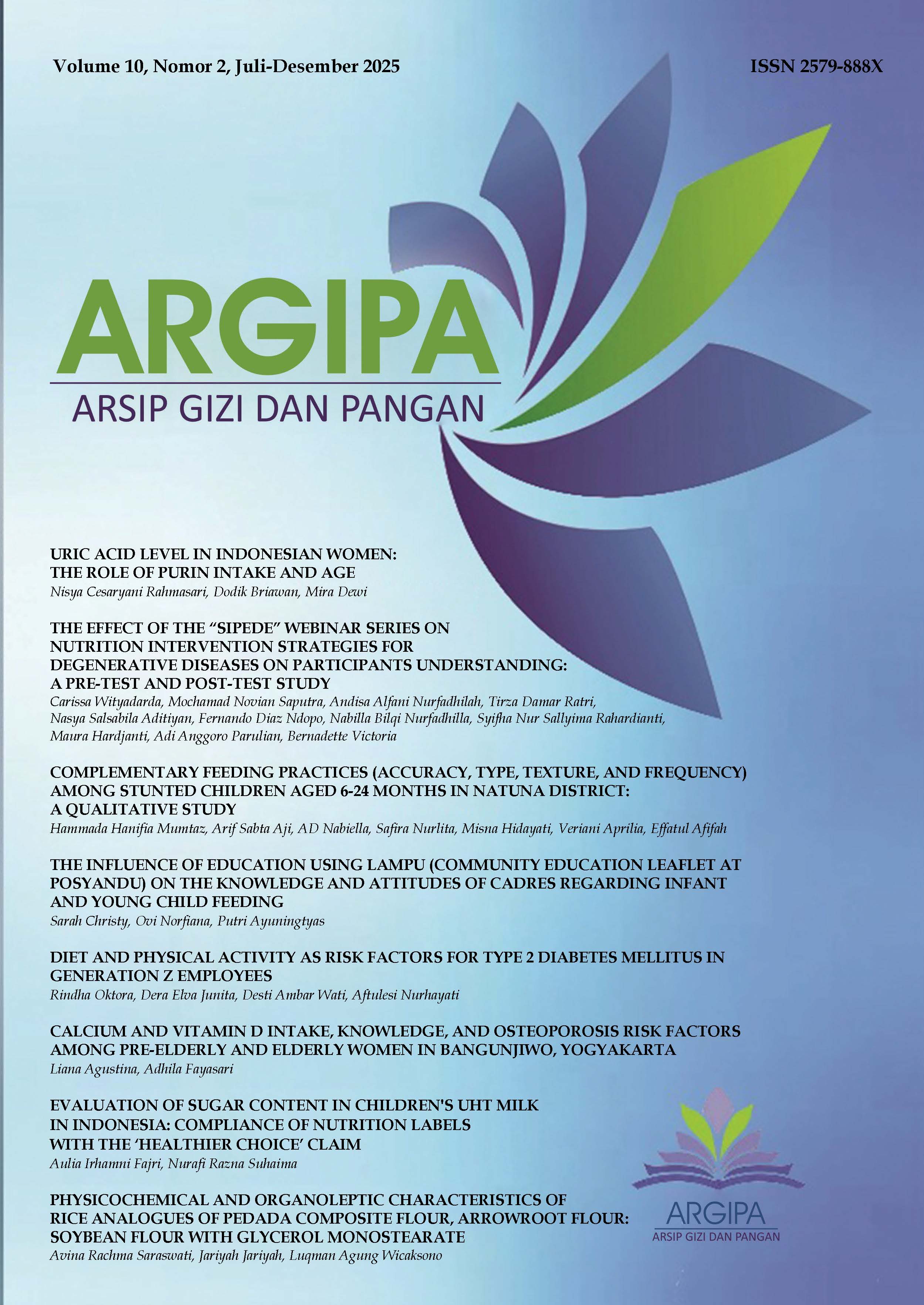
Complementary feeding practices (accuracy, type, texture, and frequency) among stunted children aged 6-24 months in Natuna district: A qualitative study
DOI:
https://doi.org/10.22236/argipa.v10i2.20308Keywords:
Child growth, Complementary food, Natuna, Practice, StuntingAbstract
Stunting is a growth failure in children under five years old due to chronic malnutrition, particularly during the first 1,000 days. This condition is generally caused by low nutritional intake and recurrent infections. It can be caused by inadequate complementary feeding. This study aimed to determine the complementary feeding practices (accuracy, type, texture, and frequency) among stunted children aged 6-24 months. This qualitative study design used a phenomenological approach with purposive non-probability sampling and was conducted in September-October 2024. Main informants were 18 mothers of children aged 6–24 months (both stunted and non-stunted), while key informants included a nutritionist and the head of the public health center in Serasan and Serasan Timur. Data were collected through Focus Group Discussion (FGD) and in-depth interviews. Data analysis was conducted thematically using NVivo 12.0. The provision of complementary foods to stunted children shows a discrepancy in timeliness with applicable recommendations. The study indicated that types of complementary food provided tend to be less diverse, especially in fulfilling the required vegetable protein intake. The texture of complementary food has not been fully adjusted to the recommended age stages of children. The frequency of complementary food provision has been carried out according to established standards. For children who are not stunted, complementary feeding is generally applicable by guidelines. Complementary feeding in stunted children needs improvement in timeliness, food variety, and age-appropriate texture, although feeding frequency generally aligns with recommendations for both stunted and non-stunted children.Downloads
References
Adriani, P., Aisyah, I. S., Wirawan, S., Hasanah, L. N., Idris, Nursiah, A., Yulistianingsih, A., & Siswati, T. (2022). Stunting pada Anak. Padang: PT Global Eksekutif Teknologi.
Afifah, E., Putri, C. A., Perkasa, P. P., Syafeti, F., Maspufah, S., Wijayanti, D., Putri, R. A., Latifah, A., Fahlevi, W. O., Muyamman, S. R., Jamalludin, M., Parena, E., & Sholihati, N. ’A. (2023). Pemberdayaan kader posyandu sebagai pendekatan holistik integral penurunan angka stunting di Banjarnegoro. JMM (Jurnal Masyarakat Mandiri), 7(6), 6234-6248.
Arumsari, R. W., Priyantini, S., & Wahyuningsih, H. (2023). Effect of education on complementary feeding using a modification method on the growth of infants aged 6-7 months: an experimental study at integrated health centers (posyandu) in Karangtengah, Demak Regency. Amerta Nutrition, 7(4), 589–595.
Bukhary, Heri, R., Elliyanti, Gunawan, H., Salim, A., Nellazandi, R., Hasimah, N., & Irfan, W. (2022). INFORMASI DATA 2022. Natunakab.Go.Id.
Dary, D., Tampil, S. A., & Messakh, S. T. (2018). Pemberian makanan pendamping asi pada bayi di Karangpete RT. 01 RW. 06 Salatiga. Jurnal Kesehatan Bakti Tunas Husada, 18(2), 278–295.
Gain, K., Khatun, S., Hossain, Md. S., & Mallick, D. R. (2020). Mothers experience about complementary feeding practice in Bangladesh. Open Journal of Pediatrics, 10(03), 423–437.
Hurint, M. T. N., Bintari, H., Yuliani, Y., Kurniasari, Y., Rahayu, H. K., & Aji, A. S. (2023). Sanitation and family environmental health status and its association with stunting in Kulon Progo, Indonesia. Journal of Global Nutrition, 3(2), 267-278.
Kemenkes RI. (2023). Hasil Survei Status Gizi Indonesia. Kementerian Kesehatan Republik Indonesia, 77–77.
Kementrian Kesehatan RI. (2023). Buku Saku Survei Kesehatan Indonesia (SKI).
Khoirunnisah, F. M., Aji, A. S., Saloko, S., Aprilia, V., Sailendra, N. V., Djidin, R. T. S., & Rahmawati, S. (2024). Pengaruh teknik penanakan terhadap sifat fisik (tekstur dan warna) nasi dari beras analog berbahan baku tepung sorgum, mocaf, glukomanan, dan kelor. Amerta Nutrition, 8(4), 506-512.
Ma, R. C. W., & Popkin, B. M. (2017). Intergenerational diabetes and obesity - a cycle to break? PLoS Medicine, 14(10), e1002415.
Mandara, F., Festo, C., Killel, E. et al. (2024). The relationship between feeding practices and stunting among children under two years in Tanzania mainland: a mixed ‑ method approach. Bulletin of the National Research Centre, 48, 112.
Marfuah, D. & Kurniawati, I. (2022). Buku Ajar Pola Pemberian Makanan Pemdamping Air Susu Ibu (MP-ASI) yang Tepat. Magetan: CV Ae Media Grafika.
Marsia, W. F., Ribay, A., Wandira, A., Indarsih, Saleh, S. W. N. M., & Jakariah, O. A. (2023). Edukasi dan pelatihan pembuatan MPASI dalam penanganan dan pencegahan stunting di Desa Manuru wilayah kerja Puskesmas Kumbewaha Kec. Siontapina. Jurnal Pengabdian Ilmu Kesehatan, 3(1), 43–49.
Merben, O. & Abbas, N. (2023). Hubungan pemberian makanan pendamping ASI (MP-ASI) dengan kejadian diare pada bayi usia 0-6 bulan di wilayah kerja Puskesmas Cigudeg tahun 2023. Jurnal Ilmiah Kesehatan BPI, 7(2), 1–8.
Mirania, A. N., & Louis, S. L. (2021). Hubungan pemberian makanan pendamping ASI (MP-ASI) dengan status gizi pada anak usia 6-24 bulan. CITRA DELIMA: Jurnal Ilmiah STIKES Citra Delima Bangka Belitung, 5(1), 45-52.
Nabilla, D. Y., Aji, A. S., Nufaisah, A., Saputri, W., Aprilia, V., Rahayu, H. K., & Salfarino, R. (2022). Pengembangan biskuit “prozi” tinggi protein dan kaya zat besi untuk ibu hamil sebagai upaya pencegahan stunting. Amerta Nutrition, 6(1SP), 79-84.
Nurkomala, S., Nuryanto, N., & Panunggal, B. (2018). Praktik pemberian MPASI (makanan pendamping air susu ibu) pada anak stunting dan tidak stunting usia 6-24 Bulan. Journal of Nutrition College, 7(2), 45-53.
Nurrahmawati, Deni, Hamim, N., & Hanifah, I. (2023). Hubungan kualitas konsumsi makanan dengan kejadian stunting di Desa Glundengan Kecamatan Wuluhan Kabupaten Jember. Jurnal Sintesis: Penelitian Sains, Terapan dan Analisisnya, 4(2), 87–96.
Paramashanti, B. A., Nugraheny, E., Suparmi, S., Afifah, T., Nugraheni, W. P., Lestyoningrum, S., D., Tumaji, T., Sulistiyowati, N., Masitoh, S., Rahayu H. K., & Afifah, E. (2024). Breastfeeding status and infectious diseases among children aged 6–23 months in Indonesia. Asian Journal of Social Health and Behavior, 7(4), 149-156.
Putri, N. F., Aji, A. S., Aprilia, V., Salfarino, R., Mz, R. B. S., Triwahyuni, N., & Triastanti, R. K. (2023). Sensory evaluation of gulu naga ijo as a complementary finger food product. Indonesian Journal of Human Nutrition, 10(2), 105-115.
Rizal, S., Sumarni, S., Aji, A. S., Fatimah, F. S., & Sarwadhamana, R. J. (2022). Stunting prevention program of West Sumbawa Regency Health Office: a qualitative study in West Nusa Tenggara, Indonesia. Open Access Macedonian Journal of Medical Sciences, 10(T8), 211–214.
Sari, D. P., Abdullah, A., Muharramah, A., & Basuki, U. (2024). Hubungan pemberian ASI eksklusif dan MPASI dengan stunting pada balita usia 6-24 bulan di Desa Sendang Ayu Kabupaten Lampung Tengah. Jurnal Kesehatan Poltekkes Palembang, 19(1), 78–85.
Sariy MZ, R. B., Sabta Aji, A., Triastanti, R. K., Veriani Aprilia, & Ryan Salfarino. (2021). Analisis Kandungan Zat Gizi Makro Pada Produk Finger Food “Gulu Naga Ijo” Sebagai MP ASI “Empat Bintang” Berbasis Pangan Lokal Kaya Antioksidan [Thesis, Universitas Alma Ata].
Sofian, A., Saputra, T., Gunawan, H., Elliyanti, Salim, A., Nellazandi, R., Hasimah, N., & Irfan, W. (2023). Informasi Data 2023. Natunakab.go.id.
Soliman, A., De Sanctis, V., Alaaraj, N., Ahmed, S., Alyafei, F., Hamed, N., & Soliman, N. (2021). Early and long-term consequences of nutritional stunting: from childhood to adulthood. Acta Biomedica, 92(1), 1–12.
Tello, B., Rivadeneira, M. F., Moncayo, A. L., Buitrón, J., Astudillo, F., Estrella, A., & Torres, A. L. (2022). Breastfeeding, feeding practices and stunting in indigenous Ecuadorians under 2 years of age. International Breastfeeding Journal, 17(1), 1–15.
Wangiyana, N. K. A. S., Karuniawaty, T. P., John, R. E., Qurani, R. M., Tengkawan, J., Septisari, A. A., & Ihyauddin, Z. (2020). Praktik pemberian MPASI terhadap risiko stunting pada anak usia 6-12 bulan di Lombok Tengah [The complementary feeding practice and risk of stunting among children aged 6-12 months in Central Lombok]. Penelitian Gizi dan Makanan (The Journal of Nutrition and Food Research), 43(2), 81–88.
Widaryanti, R. & Rahmuniyati, M. E. (2019). Panduan Pemberian Makan Bayi dan Anak bagi Kader. Yogyakarta: Respati Press.
Downloads
Published
How to Cite
Issue
Section
License
Copyright (c) 2025 ARGIPA (Arsip Gizi dan Pangan)

This work is licensed under a Creative Commons Attribution 4.0 International License.