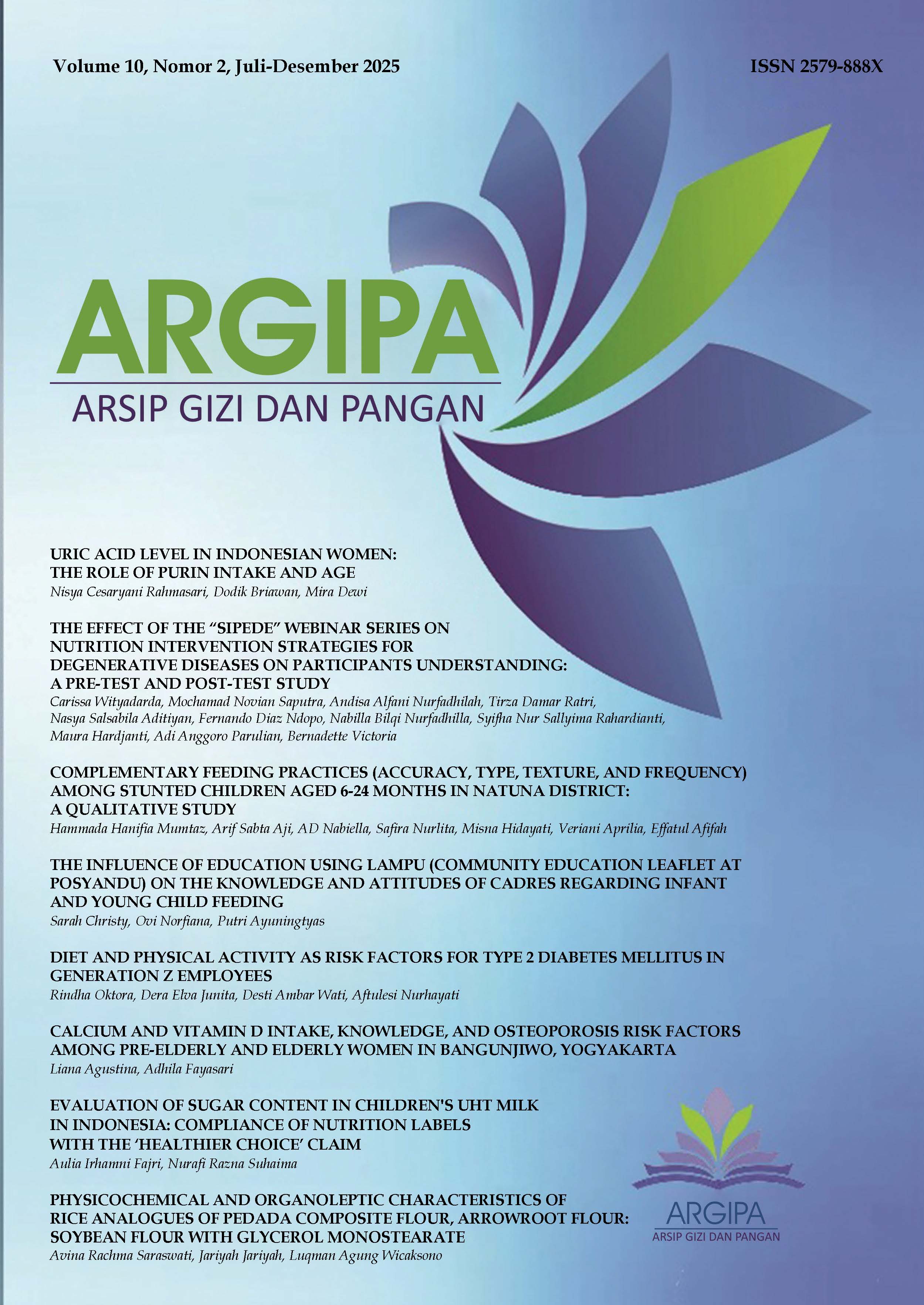
Evaluation of sugar content in children's UHT milk in Indonesia: Compliance of nutrition labels with the ‘healthier choice’ claim
DOI:
https://doi.org/10.22236/argipa.v10i2.18688Keywords:
Healthier Choice Label, Food Additives, Food Regulation, Sugar Content, Children's UHT MilkAbstract
Indonesia has implemented the front-of-pack “Healthier Choice” label to guide consumers particularly parents in selecting products with lower sugar content. However, the use of this label remains voluntary, resulting in inconsistent application across children’s UHT milk products. This study analyzes the sugar content and ingredient composition of 21 small-pack (100–125 mL) UHT milk products marketed for children and collected from five major brands: Frisian Flag, Dancow, Indomilk, Ultra Milk, and Greenfields. Findings indicate that 19 out of 21 products comply with the maximum sucrose limit established by Indonesia’s BPOM Regulation No. 26/2021 (≤6 g per 100 mL for monosaccharides and disaccharides excluding lactose). Despite this compliance, there is substantial variability in ingredient composition, including differing proportions of fresh milk, the use of recombined milk, and the presence of food additives such as synthetic colorants and flavorings. Several products displayed the “Healthier Choice” label even though they contained synthetic dyes such as ponceau 4R and tartrazine, which warrant careful monitoring in foods intended for children. Nutrient-related claims such as “contains vitamins,” “omega 3 and 6,” and “source of calcium” were often promotional in nature and lacked sufficient quantitative justification. These findings underscore the need for greater transparency in labeling and stronger regulation of ingredient composition to ensure adequate consumer protection. The study recommends harmonizing national regulations with WHO, FDA, and ASEAN policies to improve the accuracy of nutrition information and enhance the effectiveness of front-of-pack labeling systems.Downloads
References
[AHA] American Heart Association. (2017). USDA smart snacks in school beverage guidelines. https://healthymeals.fns.usda.gov/hsmrs/SmartSnacks/BeverageGuidelines.pdf
[BPOM] Peraturan Kepala Badan Pengawas Obat dan Makanan. (2016). Nomor 13 tahun 2016: Pengawasan Klaim pada Label dan Iklan Pangan Olahan.
Codex Alimentarius. (2013). Guidelines for Use of Nutrition and Health Claims—CAC/GL 23-1997.
[FAO] Food and Agriculture Organization. (2013). Milk and dairy products in human nutrition. Food and Agriculture Organization. http://www.fao.org/3/i3396e/i3396e.pdf
[FDA] Food and Drug Administration. (2016a). Changes to the Nutrition Facts label. https://www.fda.gov/forconsumers/consumerupdates/ucm094550.htm
Gomes, F. S., Ríos-Castillo, I., Leal Correa, L. R., Cruzado, B., Urquizar Rojas, C. F., Ares Devincenzi, G., González-Madden, E., & Victoria, J. (2024). Effects of front-of-package nutrition labelling systems on objective understanding and purchase intention in Panama: Results from a multi-arm parallel-group randomised controlled trial. Public Health Nutrition, 27(e192), 1–9.
https://doi.org/10.1017/S1368980024001009
Jáuregui, A., White, C. M., Vanderlee, L., Hall, M. G., Contreras-Manzano, A., Nieto, C., Sacks, G., Thrasher, J. F., Hammond, D., & Barquera, S. (2021). Impact of front-of-pack labels on the perceived healthfulness of a sweetened fruit drink: A randomised experiment in five countries. Public Health Nutrition, 25(4), 1094–1104. https://doi.org/10.1017/S1368980021004535
Krieger, J., Bleich, S. N., Scarmo, S., & Ng, S. W. (2021). Sugar-sweetened beverage reduction policies: Progress and promise. Annual Review of Public Health, 42, 439–461. https://doi.org/10.1146/annurev-publhealth-090419-103005
Mahato, D. K., Keast, R., Liem, D. G., Russell, C. G., Cicerale, S., & Gamlath, S. (2020). Sugar reduction in dairy food: an overview with flavoured milk as an example. Foods, 9(10), 1400. https://doi.org/10.3390/foods9101400
McChain, H. R., Kaliappan, S., & Drake, M. A. (2018). Invited review: Sugar reduction in dairy products. Journal of Dairy Science, 101(10), 8619–8640. https://doi.org/10.3168/jds.2017-14347
Miller, C., Ettridge, K., Pettigrew, S., Wittert, G., Wakefield, M., Coveney, J., Roder, D., Martin, J., Brownbill, A., & Dono, J. (2022). Warning labels and interpretive nutrition labels: Impact on substitution between sugar and artificially sweetened beverages, juice and water in a real-world selection task. Appetite, 169, 105818. https://doi.org/10.1016/j.appet.2021.105818
Nguyen Ngoc, H., Ditmetharoj, M., Rojroongwasinkul, N., Winichagoon, P., & Kriengsinyos, W. (2025). Assessing the healthfulness of pre-packaged beverages and investigating sugar thresholds for revising front-of-pack labels: A case study in Thailand. Frontiers in Nutrition, 12, 1564216. https://doi.org/10.3389/fnut.2025.1564216
Pries, AM., Mulder, A., Badham, J., Sweet, L., Yuen, K., & Zehner, E. (2021). Sugar content and nutrient content claims of growing-up milks in Indonesia. Maternal & Child Nutrition, 17(4), e13186. https://doi.org/10.1111/mcn.13186
Reyes, M., Smith Taillie, L., Popkin, B., Kanter, R., Vandevijvere, S., & Corvalán, C. (2020). Changes in the amount of nutrient of packaged foods and beverages after the initial implementation of the Chilean Law of Food Labelling and Advertising. PLOS Medicine, 17(7), e1003220. https://doi.org/10.1371/journal.pmed.1003220
Riesenberg D, Peeters A, Backholer K, Martin J, Ni Mhurchu C, Blake MR (2022) Exploring the effects of added sugar labels on food purchasing behaviour in Australian parents: An online randomised controlled trial. PLoS ONE 17(8): e0271435. https://doi.org/10.1371/journal.pone.0271435
Shin, S., Puri, J., & Finkelstein, E. A. (2023). A randomized trial to evaluate the impact of Singapore’s forthcoming Nutri-grade front-of-pack beverage label on food and beverage purchases. International Journal of Behavioral Nutrition and Physical Activity, 20, 18. https://doi.org/10.1186/s12966-023-01422-4
[WHO]. (2019). Policy statement and recommended actions for lowering sugar intake and reducing prevalence of type 2 diabetes and obesity in the Eastern Mediterranean Region. World Health Organization. http://www.emro.who.int/nutrition/strategy/policy-statement-and-recommended-actions-for-lowering-sugar-intake-and-reducing-prevalence-of-type-2-diabetes-and-obesity-in-the-eastern-mediterranean-region.html
Xin, Y.; Sheng, J.; Yi, F.; Hu, Y. (2024). How sugar labeling affects consumer sugar reduction: A case of sucrose grade labels in China. Foods, 13, 1803. https://doi.org/10.3390/foods13121803
Downloads
Published
How to Cite
Issue
Section
License
Copyright (c) 2025 ARGIPA (Arsip Gizi dan Pangan)

This work is licensed under a Creative Commons Attribution 4.0 International License.