
Article Sidebar
Downloads
Main Article Content
Abstract
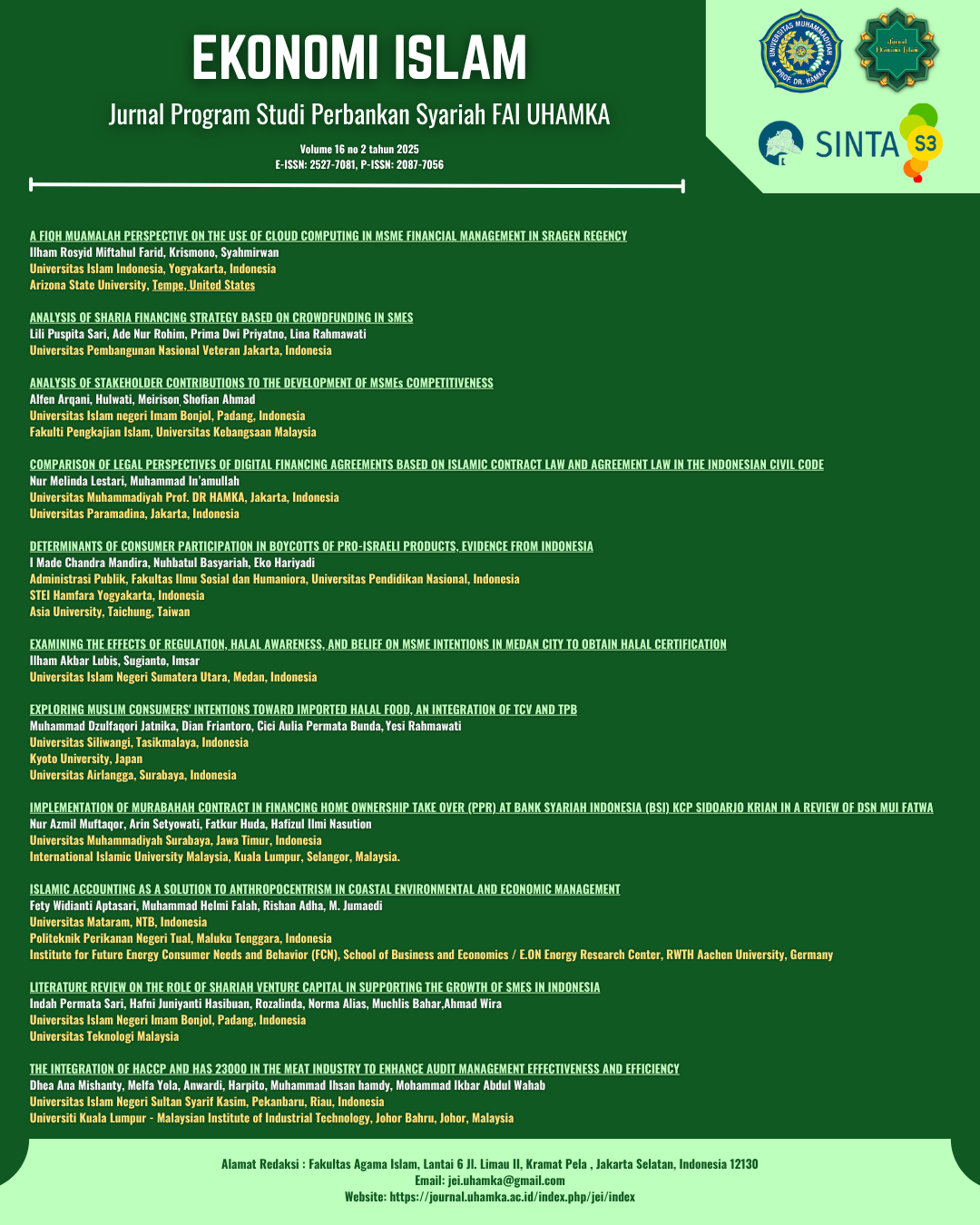
Research aims: This study aims to design and validate an integration model between the Hazard Analysis Critical Control Point (HACCP) system and the Halal Assurance System (HAS) 23000 to enhance the effectiveness of internal audits at slaughterhouses while ensuring food safety and halal compliance.
Design/Methodology/Approach: The research used a qualitative approach with the Expert Judgment method involving three experts (halal industry practitioners, industrial engineering academics, and halal quality management). The stages include: (1) mapping HACCP and HAS 23000 criteria, (2) designing an integration model based on the similarity of document functions and processes, (3) validation through a questionnaire with a scale of 1-9, and (4) feasibility analysis based on the percentage of scores.
Research findings: The validation results indicate that the HACCP–HAS 23000 integration model falls into the Highly Suitable category (average 80.4%). his model aligns HACCP Critical Control Points (CCPs) and HAS 23000 critical activities within a unified audit framework, potentially enhancing efficiency, consistency in oversight, and the integrity of the halal supply chain.
Theoretical Contribution/Originality: This study offers two innovations: (1) the first integration model specifically designed for NKV III slaughterhouses, (2) the application of Expert Judgment to align the scientific perspectives of HACCP and HAS 23000 sharia standards.
Practitioners/Policy Implications: For RPH, this model has the potential to simplify internal audits and reduce document duplication. For BPJPH, it can be adopted as technical guidelines for halal certification for small-scale RPH. Globally, it offers a solution for countries with fragmented halal certification.
Research Limitations/Implications: The study was limited to three expert respondents and focused on one slaughterhouse case. Future research should validate the model across multiple facilities and expand the expert panel. Long-term implementation studies are needed to assess practical effectiveness.
Article Details

This work is licensed under a Creative Commons Attribution-NonCommercial-ShareAlike 4.0 International License.
Authors who publish with this journal agree to the following terms:
Authors retain copyright and grant the journal right of first publication with the work simultaneously licensed under a Creative Commons Attribution License that allows others to share the work with an acknowledgement of the work's authorship and initial publication in this journal.
Authors are able to enter into separate, additional contractual arrangements for the non-exclusive distribution of the journal's published version of the work (e.g., post it to an institutional repository or publish it in a book), with an acknowledgement of its initial publication in this journal.
Authors are permitted and encouraged to post their work online (e.g., in institutional repositories or on their website) prior to and during the submission process, as it can lead to productive exchanges, as well as earlier and greater citation of published work (See The Effect of Open Access).