
Article Sidebar
Downloads
Main Article Content
Abstract
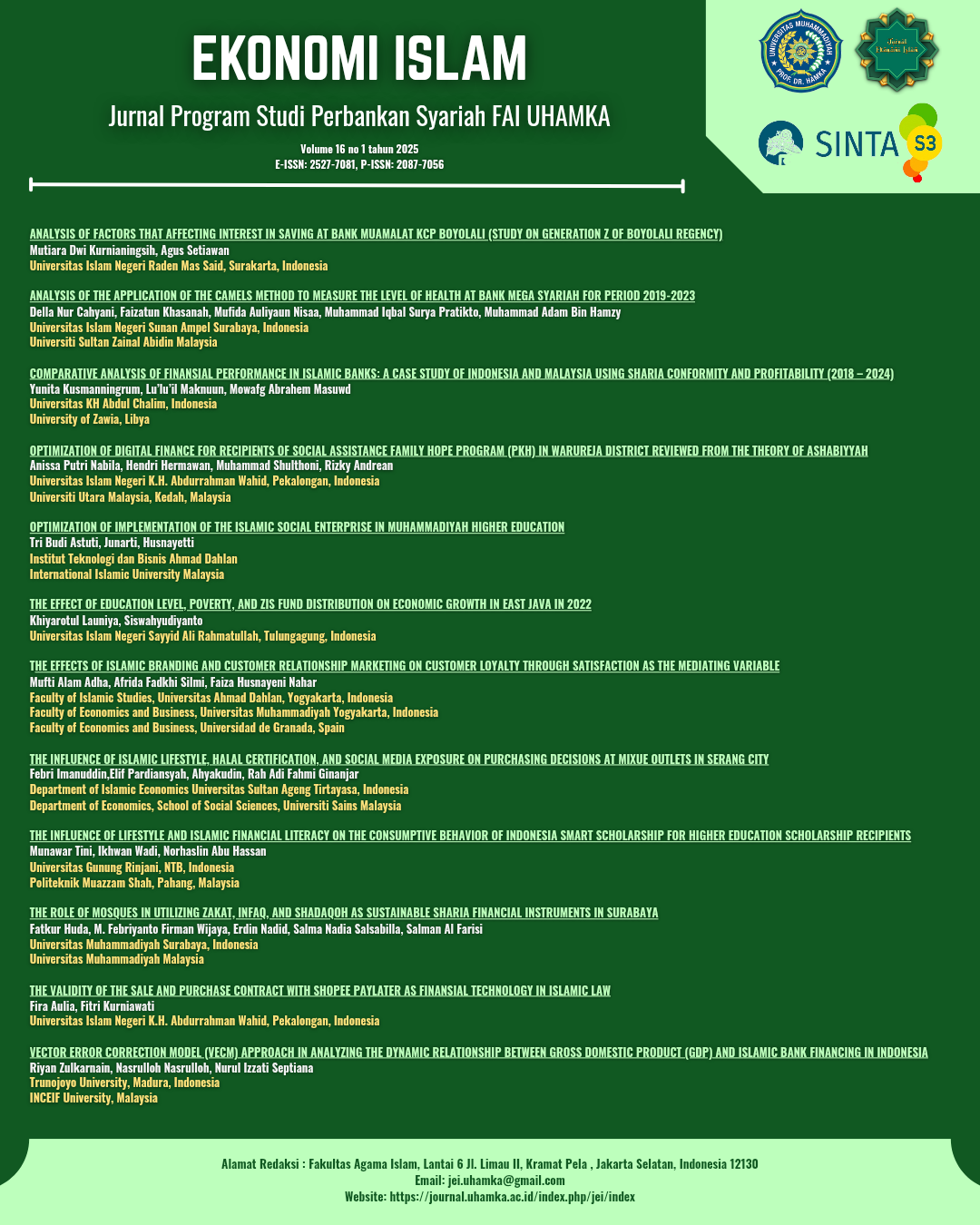
Research aims: This study aims to analyze the impact of education level, poverty, and the distribution of Zakat, Infak, and Sedekah (ZIS) funds on economic growth across districts and cities in East Java in 2022, both simultaneously and partially.
Design/Methodology/Approach: A quantitative approach was applied using secondary data from 38 districts/cities in East Java. Saturated sampling (nonprobability sampling) was used to select the sample. Multiple linear regression analysis was conducted with SPSS version 27 after testing classical assumptions such as normality, multicollinearity, and heteroscedasticity.
Research findings: The results show that education level, poverty, and ZIS fund distribution simultaneously have a significant positive effect on economic growth. Individually, each variable also significantly contributes to economic growth in the study area.
Theoretical Contribution/Originality: This study contributes to human capital theory and the poverty trap theory by empirically examining how education, poverty, and ZIS funds influence economic growth in East Java. The finding that poverty positively affects economic growth offers new insights into the socioeconomic dynamics in regions with relatively high poverty rates.
Practitioners/Policy Implications: The findings suggest that regional governments, BAPPEDA, BAZNAS, and policymakers should focus on improving education quality, productively reducing poverty, and optimizing ZIS fund distribution to promote sustainable and equitable economic growth.
Research Limitations/Implications: This study is limited to data from 2022 and focuses only on education, poverty, and ZIS distribution, which may not capture all factors influencing economic growth. Future research should include additional variables and longer time periods for more comprehensive and generalizable results
Article Details

This work is licensed under a Creative Commons Attribution-NonCommercial-ShareAlike 4.0 International License.
Authors who publish with this journal agree to the following terms:
Authors retain copyright and grant the journal right of first publication with the work simultaneously licensed under a Creative Commons Attribution License that allows others to share the work with an acknowledgement of the work's authorship and initial publication in this journal.
Authors are able to enter into separate, additional contractual arrangements for the non-exclusive distribution of the journal's published version of the work (e.g., post it to an institutional repository or publish it in a book), with an acknowledgement of its initial publication in this journal.
Authors are permitted and encouraged to post their work online (e.g., in institutional repositories or on their website) prior to and during the submission process, as it can lead to productive exchanges, as well as earlier and greater citation of published work (See The Effect of Open Access).