
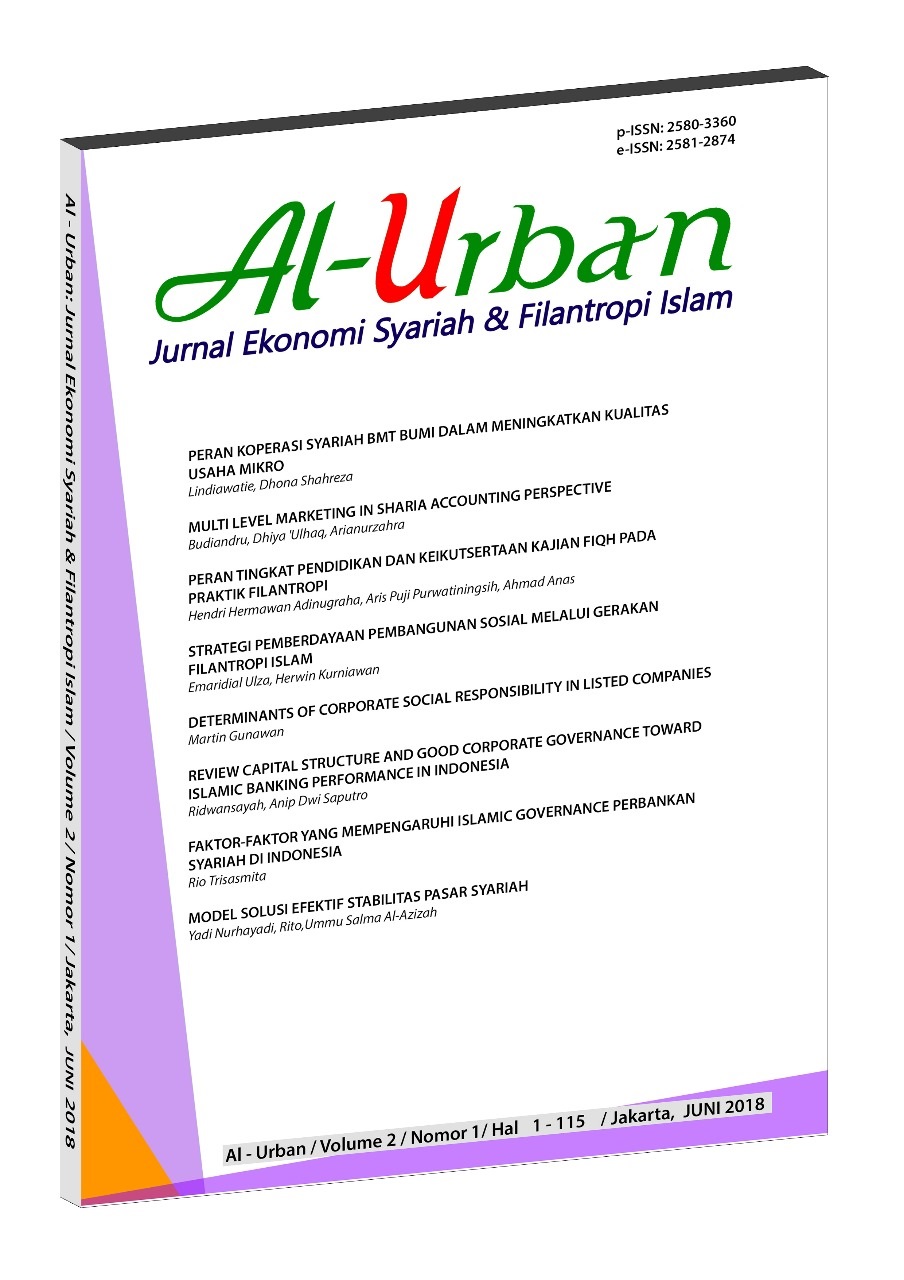
Strategi Pemberdayaan Pembangunan Sosial Melalui Gerakan Filantropi Islam
DOI:
https://doi.org/10.22236/alurban%20_vol2/is1pp32-42Keywords:
Phylanthropy, social development, empowerment movement, economicAbstract
This research would like to see the patterns of Social Development Empowerment Through Islamic Philanthropy Movement. The main problem in philanthropy is the lack of proper strategy in implementing Lembaga Amil Zakat (LAZ) and Badan Amil Zakat (BAZ) in Indonesia. In particular the philanthropy movement undertaken by Lazismu does not run evenly in every region. There are only certain Lazismu such as Lazismu Central Java, Lazismu East Java, and Lazismu Yogyakarta. One example of Lazismu Central Java in the month of Ramadan managed to collect money of 37 billion. This figure is a fantasy number that can be collected in just 1 month by this newly established philanthropic institution. The results of this study produce relationships with others. Islamic philanthropy and eminent empowerment strategy became a better philanthropic movement of Islam.
Downloads
References
Anheier, H. K., & Leat, D. (2006). Creative philanthropy: Toward a new philanthropy for the twenty-first century. Routledge.
Abdurrazaq, A. (2016). Pengembangan Model Pembangunan Ummat Melalui Lembaga Filantropi Islam Sebagai Bentuk Dakwah bil Hal. Intizar, 20(1), 163-180.
Alam, N. (2010). Islamic venture philanthropy: A tool for sustainable community development.
Arman, A. (2017). Muslim Philanthropy. [online] Foreign Policy Blogs. Available at: https://foreignpolicyblogs.com/2014/04/24/reaffirmation-of-islamic philanthropy-a-reflection/[Accessed 10 Sep. 2017].
Bahagia, P. (2017). Inilah Jumlah Infaq Abu Bakar, ‘Umar, ‘Utsman, dan ‘Abdurrahman bin ‘Auf | Kisahikmah.com. [online] Kisahikmah.com. Available at: http://kisahikmah.com/inilah-jumlah-infaq-abu-bakar-umar-utsman-dan-abdurrahman-bin-auf/ [Accessed 10 Sep. (2017)].
Bps.go.id. (2017). Badan Pusat Statistik. [online] Available at: https://www.bps.go.id/subjek/view/id/23 [Accessed 10 Sep. (2017)].
Center, F. (2017). A New Era of Muslim-American Philanthropy Requires Fewer Obstacles to Giving. [online] Philanthropy News Digest (PND). Available at: http://philanthropynewsdigest.org/commentary-and-opinion/new-era-of-muslim-american-philanthropy [Accessed 10 Sep. 2017].
Csis.org. (2017). Understanding Islamic Charities | Center for Strategic and International Studies. [online] Available at: https://www.csis.org/analysis/understanding-islamic-charities [Accessed 10 Sep. (2017)].
Departemen Agama Republik Indonesia. (2005). Al-Qur'an Terjemahan. Jakarta. PT. Syamil. Cipta Media. Dewan Penerjemah Al-Qur'an
Fauzia, A. (2013). Faith and the state: A history of Islamic philanthropy in Indonesia (Vol. 1). Brill.
Ismail, A. G., Zaenal, M. H., & Taufiq, U. (2016). Can Islamic Philanthropy Increase Financial Inclusion? (No. 1437-2).
Jusuf, C. (2007). Filantropi Modern Untuk Pembangunan Sosial. Sosio Konsepsia, 12(1), 74-80.
Kholis, N., Sobaya, S., Andriansyah, Y., & Iqbal, M. (2013).Potret Filantropi Islam Di Daerah Istimewa Yogyakarta.
Kasdi, A. (2016). Filantropi Islam Untuk Pemberdayaan Ekonomi Umat (Model Pemberdayaan ZISWAF di BMT Se-Kabupaten Demak).IQTISHADIA Jurnal Kajian Ekonomi dan Bisnis Islam, 9(2), 227-245.
Latief, H. (2012). Islamic charities and social activism: welfare, Dakwah and politics in Indonesia (Doctoral dissertation, Utrecht University).
Media Islam Salafiyyah, Ahlussunnah wal Jama'ah. (2017). Abdurrahman Bin Auf (Sahabat Yang Sangat Dermawan). [online] Available at: https://almanhaj.or.id/3801-abdurrahman-bin-auf-sahabat-yang-sangat-dermawan.html [Accessed 10 Sep. 2017].
Nasrullah, A. (2015). Pengelolaan Dana Filantropi Untuk Pemberdayaan Pendidikan Anak Dhuafa (Studi Kasus pada BMH Cabang Malang Jawa Timur). HUNAFA: Jurnal Studia Islamika, 12(1), 1-18.
Noor, A. H. B. M., Isa, N. A. M., Irpan, H. M., Bahrom, H. B., Salleh, A. B. M., & Ridzuan, A. R. B. (2015). Characteristic Affecting Charitable Donations Behavior: Empirical Evidence from Malaysia. Procedia Economics and Finance, 31, 563-572.
Philanthropy-impact.org. (2017). Universal Basic Income - Why Now, Some Basics | Philanthropy Impact. [online] Available at: http://www.philanthropy-impact.org/article/philanthropy-origins-and-reflections-middle-east [Accessed 10 Sep. 2017].
Rochaety, E., Tresnati, R., & Latief, A. M. (2007). Metodologi penelitian bisnis dengan aplikasi SPSS. Jakarta: Mitra Wacana Media.
Suherman. (2016). Strategi Pemberdayaan masyarakat Muslim Melalui Tradisi Berdarma Pada Organisasi Filantropi Agama di Kota Medan. Core Uk.12(2).
Sarwono, J. (2006). Metode Penelitian. Kuantitatif Kualitatif.
Sugiyono, D. (2008). Metode Penelitian Bisnis. Bandung: Pusat Bahasa Depdiknas.
Sumanto, A. (2016). Islam dan Masalah Kemiskinan di "Dunia Muslim” | indonesia | DW | 14.12.2016. [online] DW.COM. Available at: http://dw.com
Tamim, I. H. (2011).Peran Filantropi dalam Pengentasan Kemiskinan di dalam Komunitas Lokal.Jurnal Sosiologi Islam, 1(1).
Tempo Bisnis. (2017). Maret 2017, Jumlah Penduduk Miskin Indonesia Capai 27,77 Juta. [online] Available at: https://bisnis.tempo.co/read/news/2017/07/17/090892130/Maret-2017-Jumlah-Penduduk-Miskin-Indonesia-Capai-27-77-Juta [Accessed 10 Sep. 2017].
(www.dw.com), D. (2017). Islam dan Masalah Kemiskinan di "Dunia Muslim” | indonesia | DW | 14.12.2016. [online] DW.COM. Available at: http://www.dw.com/id/islam-dan-masalah-kemiskinan-di-dunia-muslim/a-36759510 [Accessed 10 Sep. 2017].
Downloads
Published
How to Cite
Issue
Section
License
The Author submiting a manuscript do so on the understanding thet if accepted for publication, copyright of the article shall be assigned to Al-Urban: Jurnal Ekonomi Syariah dan Filantropi Islam, Faculty of Economics and Business, University of Muhammadiyah Prof. DR. HAMKA.
Copyright encompasses exclusive right to reproduse and deliver the article in all form and media, including reprint, photographs, microfilms and any other similar reproductions, as well as transalations. The reproduction of any part of this journal., its storage in database and its transmission by any form or media such as electronic, electrostatic and mechanical copies, photocopies, recordings, magnetic media, etc..will be